

Available 24/7Serving City of Falls Church / Fairfax County
Water Damage Restoration in Falls Church, VA
Water out, house dry, rooms rebuilt. One crew does all three.
- 4.9 on Google
- One crew, dry-out to rebuild
- Available 24/7Nights, weekends, holidays
- 42-year builderOwner Curtis Berg, journeyman
- Navy Seabees veteranThe Navy's construction force
- Adjuster-ready recordsPhotos, readings, estimate
We restore water-damaged homes across Falls Church, in the City of Falls Church and in the Fairfax County neighborhoods with a Falls Church address. We answer 24/7, then extract the water, dry the house, document the damage for your insurer and rebuild.
Water damage in Falls Church homes, and where it starts
A Falls Church address can mean two different governments. The City of Falls Church, the "Little City," is an independent city with its own permits and its own stormwater program, covered by ZIP code 22046. The rest of Falls Church is Fairfax County: Baileys Crossroads and Lake Barcroft in 22041, the 22042 area, Pimmit Hills and Idylwood in 22043, and Seven Corners in 22044. The houses in these areas were built decades apart, so a leak in one acts nothing like a leak in another.
Older homes inside the City
Some of the oldest houses in the area are inside the City. Broadmont and East Falls Church have homes built as early as 1918. Greenway Downs and Virginia Forest date to the early 1940s. Winter Hill, built in 1949, is mostly condominiums, and Cherry Hill Townhomes went up in 1978 and 1979.
Older houses hide water in different ways than new ones. Plaster walls hold moisture longer than drywall and take more care to dry without cracking. Original cast iron or clay drain lines, where they are still in place, can crack or root up and back water into a basement. In a 1940s house with several additions, water from one leak can run along an old framing line into a room you would not expect.
Pimmit Hills and the 1950s slab houses
Pimmit Hills, in 22043, was built out between 1950 and the late 1950s with about 1,675 homes. Most of the early houses were small, and the neighborhood's own history says a large share were built on a slab or a crawlspace instead of a basement. That changes the cleanup:
- On a slab, a supply line or water heater leak spreads under flooring and wicks into the bottom of every wall it touches. There is no basement to drain into, so the water sits where you live.
- Over a crawlspace, a leak can run for weeks before you notice a soft floor or a musty smell. By then the insulation is soaked and the subfloor may need to come out.
- Next to a teardown, a large new house with a full basement can change the grading between lots. When the yards drain differently, rain can end up running toward the older, lower house.
Holmes Run Acres and Lake Barcroft
Holmes Run Acres was built between 1951 and 1958 and is listed on the National Register of Historic Places. Its houses are mid-century modern, with lots of wood and glass, which sets them apart from the brick ramblers and split-levels around them. On homes with long runs of windows and low-pitched roofs, water from a roof or flashing leak can travel along a beam and show up far from where it got in. Repairs on these houses need a builder who respects the original design.
Lake Barcroft, in 22041, was developed in the early 1950s around a private lake. Many homes sit on sloped lots, and a lower level that faces downhill can take on water when a heavy storm overwhelms the yard drains.
Tripps Run, Four Mile Run and flash floods
Tripps Run and Four Mile Run carry water through the City toward the Potomac. In September 2011, flooding hit the floodplain corridors of both streams. On July 8, 2019, more than three inches of rain fell on the City in about an hour and a half. Tripps Run flooded into backyards and basements, and the South Oak Street bridge was damaged. A storm like that can leave flooded basements across a whole neighborhood at once, including in homes that had never taken on water before.
From the first call to the finished room
When you call, we stop the water, extract it and set drying equipment. We take moisture readings on every visit until the structure is dry, and we photograph the damage and write the estimate as we go. We send that documentation to your insurer and meet your adjuster at your home. Then the same crew does the rebuild, from drywall and insulation to flooring, trim and paint. The company is owned by Curtis Berg, a Navy Seabees veteran with 42 years as a journeyman builder, so an old house gets put back together by people who build for a living.
Our process
Our process in Falls Church: extract, dry, document, rebuild
Four steps, one crew, one phone number.
- Step 1
Stop the water and pull it out
We find where the water is coming from, stop it, and extract standing water from floors, carpet and the structure.
- Step 2
Dry it out
We set dehumidifiers and air movers and take moisture readings each visit. The equipment stays until the readings say dry.
- Step 3
Document it for your adjuster
We photograph the damage, log every moisture reading, and write the estimate. We send that documentation to your insurer and meet your adjuster on site.
- Step 4
Build it back
The same crew replaces drywall, insulation, flooring, trim and paint. No handoff to a second contractor.
Insurance documentation
We work for you, not your insurance company
You hire us and we bill you. Then we give your insurer the paperwork they ask for, so you are not chasing photos and receipts while your house is torn open.
Your insurance company decides what your policy covers. We are a restoration contractor, not a public adjuster.
What your adjuster gets
Sent to your insurer, in writing
- Photos of the damage before, during and after
- Moisture readings logged on every visit
- A written estimate for the dry-out and the rebuild
- Documentation sent to your insurer
- We meet your adjuster at your home
42years
as a journeyman builder
1crew
from first call to finished room
24/7
emergency line, nights and weekends
4.9stars
on Google
Mold
Mold after water damage in Falls Church
Mold needs water and time. Falls Church homes give it both in a few predictable places: crawlspaces under 1950s houses in Pimmit Hills, basements near Tripps Run that flooded in a storm and were never fully dried, and old plaster walls that stayed wet behind a leak. Humid summers keep those spaces damp longer, and a basement that only smells musty in August is still telling you something.
Signs to watch for are a musty smell that comes back after you clean, dark spotting on drywall, baseboards or crawlspace framing, and a floor that feels soft or cool and damp. If you see those, we can do mold inspection and testing to find out what is there and how far it goes. If it needs to come out, our mold remediation work contains the area, removes the affected material and dries what remains. Then we rebuild it, the same way we would after any water job.
Smell something musty?
Find out what you have, then get it out and dried.
Reviews
Reviews from Falls Church homeowners
Real reviews from our Google Business Profile only.
Our work
Real jobs, start to finish
Photos from our own jobs: finding the water, opening up what got wet, and drying it out.
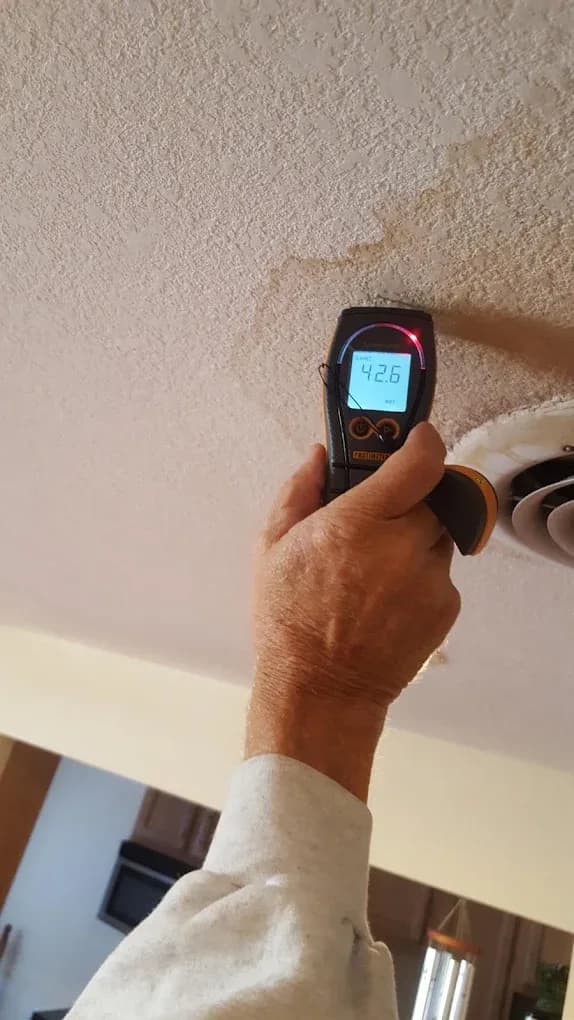
- Moisture readings
A moisture meter held against a water-stained ceiling, reading 42.6  Tear-out
Three crew members in dust masks pulling wet insulation, drywall and wiring out of a basement room  Our equipment
Air movers and dehumidifiers racked and strapped inside a work van  Mold removal
A technician in a protective suit and respirator vacuuming a concrete block wall under ductwork 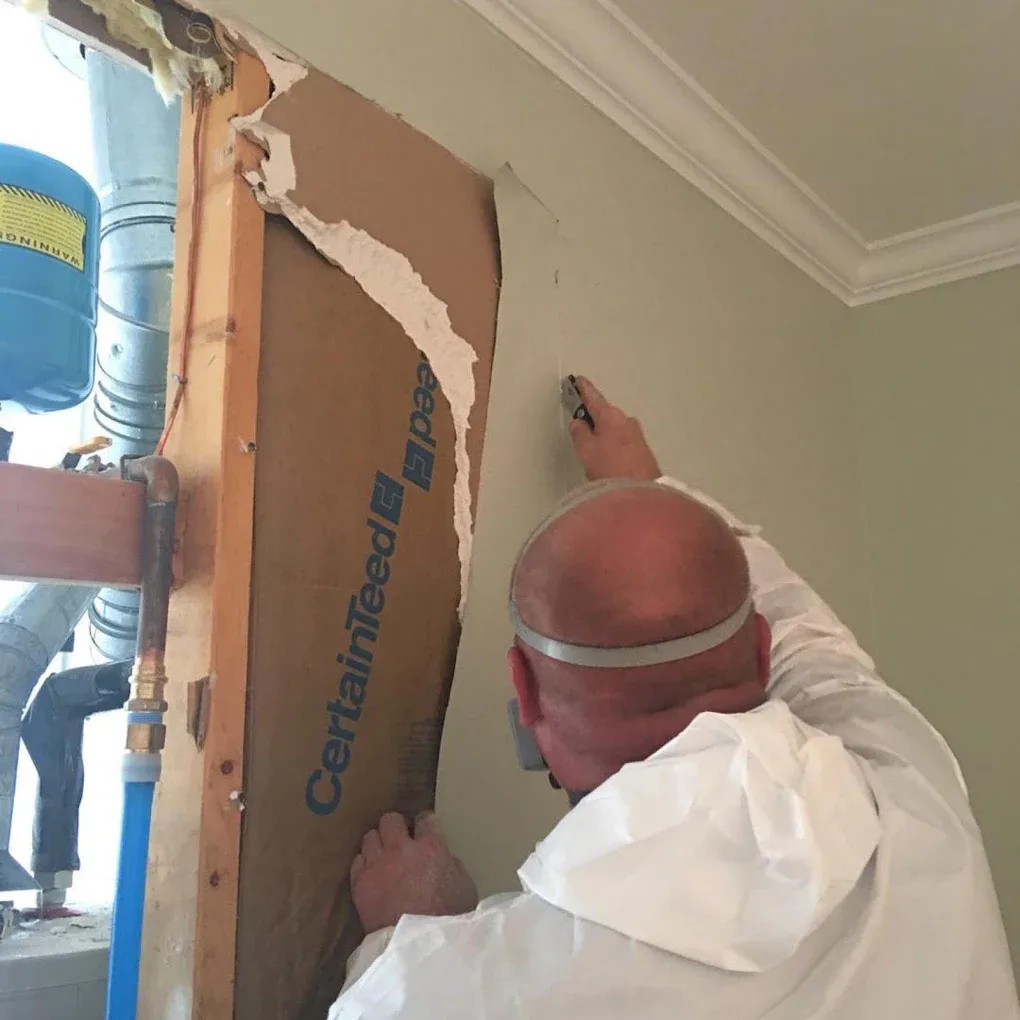 Tear-out
A technician in a protective suit cutting away drywall next to exposed pipes and a pressure tank  Inspection
A technician with a flashlight checking an opened section of ceiling above a doorway
FAQ
Water damage questions from Falls Church
Not answered here? Call (703) 783-7855, any time.
Do you serve the City of Falls Church and the Fairfax County side?
Yes. We serve both, including ZIP codes 22041, 22042, 22043, 22044 and 22046.
How fast can you get to my home in Falls Church?
Call us any time and we will give you an arrival time on the phone.
My 1950s house is on a slab. Can water damage still be dried out?
Yes. We pull up wet flooring where needed, take moisture readings at the base of the walls and dry the slab and framing until the readings say dry, then rebuild.
Do you rebuild after the water damage is dried?
Yes. The same crew that dries your home rebuilds it in-house, from drywall and insulation to flooring, trim and paint.
What do you send to my insurance company?
We send your insurer photos of the damage, moisture readings from every visit and a written estimate for the dry-out and the rebuild. We also meet your adjuster at your home. Your insurance company decides what your policy covers.
Near you
Nearby areas we serve
Services
Services in Falls Church
- Water damage restorationLeaks, overflows and flooding cleaned up and dried out.Learn more
- Burst and frozen pipesWater from a split or frozen pipe, from shutoff to rebuild.Learn more
- Flooded basementsPump-out, drying and rebuilding finished basements.Learn more
- Sewage backup cleanupSafe removal and sanitizing after a sewer or toilet backup.Learn more
- Water extraction and dryingStanding water out, then drying until readings say dry.Learn more
- Rebuild and repairDrywall, floors, trim and paint, done by the same crew.Learn more
- Mold remediationMold removed and the wet area dried out.Learn more
- Mold inspection and testingFind out if you have mold and how far it goes.Learn more
Available 24/7
Water damage in Falls Church? Call now.
The sooner the water comes out, the less has to be torn out. One crew dries it out and builds it back.